Introduction
Many growing businesses (especially MSMEs) are managing procurement through a mix of spreadsheets, emails, and disconnected tools. The result? Delayed orders, missed approvals, and financial leakage. According to Deloitte's 2025 Global CPO Survey, 74% of procurement leaders now prioritize maintaining alternate sources, while 64% focus on enabling supply chain visibility to combat these operational risks.
As a business scales, this fragmented approach compounds quickly. Vendors fall through the cracks, spending goes untracked, and finance teams are always playing catch-up.
Approximately 40% of enterprise spend remains unmanaged by the average procurement department. That dwarfs classic maverick buying, which accounts for just 1.2% of total purchases.
This guide covers what an ERP procurement system is, the key benefits it delivers, how the procurement process flows within one, implementation best practices, and how to choose the right solution for your business.
TLDR
- An ERP procurement system connects purchasing, finance, inventory, and vendor management into one unified platform — eliminating department silos across the full purchase cycle
- Key benefits include procurement automation, real-time spend visibility, improved compliance, and stronger supplier relationships
- ERP procurement follows a structured flow — from need identification and PO creation through goods receipt, invoice processing, and reporting
- Successful implementation requires clean data, configured workflows, and a phased rollout with cross-functional training
- Indian MSMEs should prioritize ERP solutions that are cloud-based, GST-compliant, and built to scale without SAP-level complexity
What Is an ERP Procurement System?
An ERP procurement system is the purchasing and procurement capability embedded within an Enterprise Resource Planning (ERP) platform — a unified software solution that connects procurement with finance, inventory management, supplier data, and business operations through a single shared database.
Core functions in an ERP procurement module include:
- Purchase requisition and PO management
- Supplier and contract management
- Invoice processing and three-way matching
- Inventory-linked reordering
- Spend reporting and analytics
Standalone e-procurement tools handle purchasing workflows in isolation. ERP procurement does the same job — but every purchase order automatically updates financials, inventory, and cash flow commitments without manual handoffs.
For Indian MSMEs in particular, this integration also means GST-compliant purchase records feed directly into accounting and e-invoicing workflows, eliminating a reconciliation step that trips up many growing businesses. The result: fewer data silos, no version conflicts, and no after-the-fact spreadsheet fixes.
Key Benefits of ERP Procurement Systems
Centralized Data and Elimination of Silos
ERP procurement replaces the patchwork of spreadsheets, emails, and disconnected tools with a single source of truth. Every team — finance, operations, procurement — works from the same real-time data, reducing errors and miscommunication. When a purchase order is created, inventory teams see it instantly. When goods are received, finance knows immediately. No more chasing updates or reconciling conflicting records.
Procurement Automation
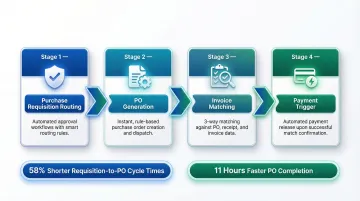
Automation transforms procurement from a manual, time-consuming process into an efficient, structured workflow. Here's what gets automated:
- Purchase requisitions routed to the right approvers based on spend thresholds
- PO generation from approved requisitions
- Invoice matching against POs and receipts
- Payment triggers once three-way matching is complete
Top-performing procurement organizations execute 58% shorter requisition-to-purchase order cycle times compared to peers. Companies using automated software complete their PO cycle 11 hours faster than those using manual processes.
Real-Time Spend Visibility and Cost Control
ERP procurement gives managers real-time dashboards showing spend by vendor, category, and department. This visibility enables proactive budget management, early identification of overspending, and stronger negotiating leverage with suppliers.
The financial impact is substantial. Top-performing procurement organizations operate at a 19% lower cost as a percentage of spend and use 31% fewer full-time employees while generating 2.03 times greater cost savings compared to average performers.
Improved Supplier Relationship Management
ERP systems centralize all vendor data — contracts, pricing agreements, order history, payment terms, and performance metrics — so every team member is aligned on vendor status. This reduces relationship gaps when team members change and supports more informed negotiations.
Superior Supplier Relationship Management (SRM) programs report combined incremental cost savings and operational cost benefits of 3.2%, representing 26% of total annual savings achieved by procurement functions.
Compliance, Audit Trails, and Risk Reduction
ERP procurement enforces purchasing policies through automated approval workflows, prevents unauthorized or duplicate purchases, and maintains a complete audit trail of every transaction.
The risk reduction is significant. Billing schemes account for 22% of occupational fraud cases, with a median loss of ₹84 lakh per incident. Separately, more than half of all fraud cases are traced back to insufficient internal controls. ERP systems mitigate these risks by enforcing segregation of duties and immutable audit logs.
Better Decision-Making Through Analytics and Reporting
ERP procurement systems automatically generate reports comparing vendor costs, delivery performance, and defect rates. Leadership gets the data needed to make smarter sourcing and planning decisions . Cloud-enabled supplier management has shown 16% improvement in orders completed on time in full (OTIF) and 21% reduction in lead times.
How Procurement Works Within an ERP: Step by Step
A well-configured ERP structures procurement into a defined, traceable sequence — eliminating unplanned purchasing and making the entire cycle visible and controllable.
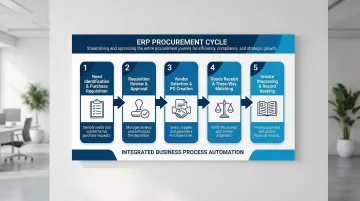
Step 1: Need Identification and Purchase Requisition
The process begins when a team member identifies a need and submits an electronic purchase requisition (PR) through the ERP, specifying item, quantity, budget code, and urgency. This replaces informal requests via email or verbal communication with a structured, documented process.
Step 2: Requisition Review and Approval
The ERP automatically routes the PR through a configured approval hierarchy (manager, finance, procurement head) based on spend amount and category. Notifications keep the process moving, escalations prevent bottlenecks, and a full approval audit trail ensures accountability.
Step 3: Vendor Selection and PO Creation
The ERP enables procurement teams to compare approved vendors, review past pricing, and generate purchase orders directly from approved requisitions. This eliminates duplicate data entry and ensures POs are tied to budget availability.
Step 4: Goods Receipt and Three-Way Matching
Three-way matching is the core AP control that stops overbilling, invoice discrepancies, and fraudulent payments before they're processed. The process verifies three criteria:
- Quantity billed ≤ Quantity ordered (Purchase Order)
- Invoice price ≤ Purchase order price
- Quantity billed ≤ Quantity received (Goods Receipt Note)
If the invoice and purchase order don't match within predefined tolerances, the ERP automatically places a "matching hold" on the invoice, requiring manual release before payment. This directly addresses the 8-12% manual error rate common in manual AP processes. Duplicate payments alone account for approximately 1.5% of an organization's total outgoing cash flow — a leakage three-way matching systematically eliminates.
Step 5: Invoice Processing, Payment, and Record Keeping
Matched invoices are routed for payment processing within the ERP, with transactions automatically posted to accounts payable, inventory, and the general ledger. Every transaction is time-stamped and traceable, giving finance teams a clean audit trail for GST reconciliation, statutory audits, and period-end closing.
According to Ardent Partners' AP Metrics That Matter in 2025, Best-in-Class organizations process invoices at $2.82 per invoice versus $13.08 for all others, achieving touchless processing rates of 49.2% compared to 23.4%.
Best Practices for ERP Procurement
Getting an ERP live is just the starting point. The real value comes from how well the system is configured and followed through on every day.
Maintain Clean, Standardized Master Data
Poor data quality — duplicate vendors, inconsistent product codes, outdated pricing — undermines every ERP benefit. Standardize and clean vendor and item master data before go-live, then enforce data governance policies going forward.
Practical steps to maintain data integrity:
- Assign ownership for each data category (vendors, items, pricing)
- Schedule quarterly audits to flag duplicates and outdated records
- Define clear approval rules for creating new vendor or item entries
Configure Approval Workflows That Match Your Business
Generic, out-of-the-box approval flows often get bypassed by users who find them misaligned with how the business actually works. Workflows should reflect your organizational hierarchy, spend thresholds, and category rules — so the system keeps policy on track instead of being routed around. For example:
- Purchases under ₹10,000: Department manager approval only
- ₹10,000–₹50,000: Manager + Finance approval
- Above ₹50,000: Manager + Finance + Procurement head
Run Regular Spend Analysis
Schedule periodic spend analysis reviews within the ERP — looking at vendor consolidation opportunities, off-contract purchases, and category-level trends. Done consistently, this surfaces savings opportunities and process gaps before they compound. Track the percentage of spend under contract (target: >80%) and maverick spend rate (target: <1.2%).
Train Finance and Procurement Teams Together
ERP procurement spans both departments, so siloed training creates misalignment. Joint onboarding sessions close that gap. Each team needs to understand how their actions affect the other:
- Finance teams: how purchase decisions flow into AP, accruals, and reporting
- Procurement teams: how budget constraints and approval rules are set by finance
Track KPIs and Conduct Periodic System Audits
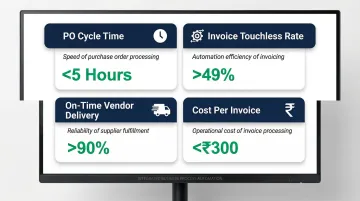
Set procurement KPIs within the ERP and review them regularly:
- PO cycle time (Target: <5 hours for top performers)
- Invoice approval rate (Target: >49% touchless)
- On-time delivery from vendors (Target: >90%)
- Cost per invoice (Target: <₹300)
Periodic system audits are equally important — they typically surface unused approval workflows, misaligned spend categories, and GST compliance gaps that erode accuracy over time.
How to Implement an ERP Procurement System
Phase 1 – Assess, Plan, and Define Requirements
Implementation starts with understanding exactly where your procurement process stands today. Involve finance, IT, and procurement stakeholders from day one to ensure buy-in and set realistic timelines.
Document your current state before touching any software:
- Monthly purchase order volume and vendor count
- Existing approval levels and who authorises what
- Current pain points — delays, duplicate orders, missed payments
- Measurable goals that will define success post-implementation
Phase 2 – Configure, Migrate Data, and Integrate
This phase handles the technical groundwork: configuring approval workflows, migrating vendor master data, integrating with your existing finance or inventory systems, and assigning user access roles.
Data quality during migration is critical. Poor source data produces unreliable outputs from day one. Before go-live, clean vendor lists, standardise item codes, validate pricing agreements, and run full integration tests.
Phase 3 – Pilot Testing, Training, and Go-Live
Start with a phased go-live: pilot with one team or business unit, collect feedback, fix configuration gaps, then roll out fully. Structured user training before go-live is non-negotiable — adoption rates ultimately determine ROI.
On timeline: according to Panorama Consulting Group's 2025 ERP study, the average implementation dropped to 9 months in 2025, down from 15.5 months in 2024 — largely because SaaS models remove on-premise infrastructure setup. For Indian MSMEs, expect a realistic range of 3 to 9 months depending on business complexity.
Choosing the Right ERP Procurement Solution for Your Business
Evaluate ERP solutions based on these criteria:
- Scalability to grow with the business
- Depth of procurement-specific features (requisitions, approvals, three-way matching)
- Ease of integration with finance and inventory
- Quality of reporting and real-time dashboards
- Total cost of ownership (subscription, implementation, training)
- Vendor support and training resources
India-Specific Considerations
For Indian MSMEs, the ERP must handle GST compliance natively, including e-invoicing and IRN generation. E-invoicing is mandatory for taxpayers with an aggregate turnover exceeding ₹5 Crore from August 1, 2023. Effective April 1, 2025, taxpayers with a turnover of ₹10 Crore and above must report e-invoices within 30 days from the invoice date.
Many global ERPs require costly customization to meet Indian compliance requirements. Common gaps include:
- Configuring the tax engine for CGST, SGST, and IGST
- Setting up tax nexuses across different states
- Managing Reverse Charge Mechanism (RCM)
- API integration with the IRP to capture returned IRN and QR codes
These are not minor configurations — each adds implementation time, consulting cost, and ongoing maintenance risk for MSMEs with limited IT resources.
Bizionix: Purpose-Built for Indian MSMEs
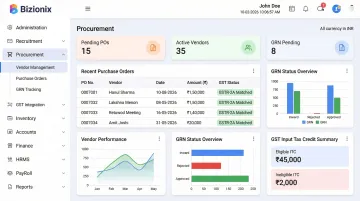
Bizionix by IIS-LLP addresses those compliance challenges directly. Built for the Indian business context, it brings procurement, GST-ready accounting, real-time spend visibility, and multi-company management into a single cloud-based platform — without the implementation overhead that enterprise-grade systems typically demand.
Core procurement capabilities include:
- Vendor management and purchase order processing
- Goods receipt notes (GRN) and consumption analytics
- GST-compliant financial modules integrated end-to-end
- Direct API integration with the GST e-Invoice system for instant IRN generation and real-time validation
No manual steps, no third-party tools — the compliance workflow runs within the same platform.
At ₹999 annually for the basic plan, Bizionix replaces 5–6 separate tools that MSMEs typically use. The fully cloud-based architecture provides 24/7 access with no on-premise infrastructure required.
Frequently Asked Questions
What is the difference between an ERP procurement system and an e-procurement system?
ERP procurement is embedded in a broader business platform linking purchasing to finance, inventory, and operations, while e-procurement is a standalone tool focused exclusively on purchasing workflows. Both can be used together — e-procurement handling specialized sourcing and ERP managing the integrated financial and operational impact.
What are the 7 stages of procurement in an ERP system?
The key stages are: need identification, purchase requisition, requisition review and approval, vendor selection and PO creation, goods receipt, invoice processing and three-way matching, and record keeping/reporting. Each stage is documented and traceable within the ERP.
How long does it take to implement an ERP procurement system?
Timelines range from a few weeks for cloud-based out-of-the-box systems to several months for complex, customized deployments. Small and mid-sized businesses typically complete implementation in 3 to 9 months, with phased rollouts helping keep timelines on track.
How does an ERP system help with supplier management?
ERP centralizes vendor contracts, pricing, order history, and performance data — enabling better negotiations, faster onboarding of new suppliers, and consistent relationship management across teams. For Indian MSMEs managing multiple vendors, this single source of supplier data reduces disputes and speeds up procurement cycles.
Can a small or mid-sized business afford an ERP procurement system?
Yes. Modern cloud-based ERP solutions are increasingly affordable for MSMEs — many offer modular pricing, and the ROI from reduced procurement errors, saved time, and better spend control typically offsets the cost quickly. For Indian MSMEs in particular, cloud ERP eliminates the need for expensive on-premise infrastructure, keeping total cost of ownership low.
What are the biggest challenges in ERP procurement implementation?
Top challenges include poor data quality during migration, low user adoption, misconfigured workflows that teams work around, and underestimating the training needed across procurement and finance functions. Address these through thorough data cleaning, phased rollouts, joint training sessions, and continuous system audits.