Introduction
At some point, spreadsheets stop being a solution and start being the problem. For most MSMEs, that point arrives when transaction volumes climb, teams grow, and GST compliance deadlines don't wait. Fragmented tools create fragmented results: delayed reporting, manual follow-ups, and errors that cost real money.
ERP software exists precisely for this stage — when managing operations across disconnected systems becomes unsustainable.
The real value of ERP shows up in daily outcomes, not spec sheets: faster billing cycles, fewer compliance errors, tighter financial control, and decisions grounded in accurate data. This article breaks down the key ERP features that matter most for growing businesses — covering financial management, inventory, GST compliance, reporting, and more — and explains why each one makes a practical difference.
TLDR
- ERP consolidates data from all departments into one platform, eliminating silos and enabling coordinated operations
- Automated invoicing, expense tracking, and GST compliance cut manual effort and reduce costly errors across finance teams
- Real-time dashboards give business owners visibility to act on data, not assumptions
- Businesses without ERP face rising costs, reactive management, and structural difficulty scaling
- Consistent ERP adoption builds measurable efficiency gains — faster billing cycles, cleaner data, and lower operational costs
What Is ERP? (Brief Context)
ERP is a unified software platform that connects core business functions—finance, operations, inventory, compliance, and reporting—so they work from one system rather than in isolation. Businesses of all sizes use ERP, but cloud-based platforms have made it increasingly accessible to Indian MSMEs at the right scale and price point.
Think of ERP as an operational decision, not an IT purchase. The real value is giving management visibility and control—instead of constantly chasing information across disconnected tools and spreadsheets.
For Indian MSMEs specifically, that means choosing a platform built around local requirements rather than adapting a generic system to fit:
- GST compliance and e-invoicing built into the accounting layer
- Multi-entity support for businesses managing more than one company or branch
- Scalable architecture that grows as headcount, locations, and transaction volumes increase
Key ERP Features and the Business Benefits They Deliver
The features below are selected for their direct, measurable impact on operations—not technical sophistication. Each addresses a specific failure mode that businesses without ERP commonly face.
Integrated Data and Business-Wide Visibility
Integration is ERP's foundational feature. It connects finance, sales, inventory, procurement, and HR into a single system where data entered in one area is immediately available to others—eliminating manual data transfers or reconciliation across spreadsheets and disconnected tools.
How it works in practice:
When a sales order is placed, it automatically updates inventory levels, triggers billing, and feeds into financial reporting—without anyone re-entering data or chasing updates across teams. For example, platforms like Bizionix connect all core modules simultaneously: finance, sales, inventory, procurement, HRMS, and CRM work from the same real-time data source.
Why this matters:
Departmental data silos are one of the leading causes of operational inefficiency. Decisions get delayed, errors occur during manual handoffs, and leaders work from incomplete or stale information. A unified data model eliminates these gaps and gives every authorized stakeholder access to the same real-time picture of the business.
The cost of fragmentation is significant:
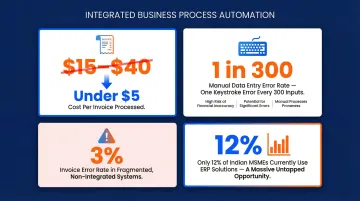
- Manual invoice processing costs $15 to $40 per invoice, while ERP-automated systems reduce this to under $5
- Data entry errors occur at a rate of 1 per 300 keystrokes in manual systems
- Nearly 3% of invoices contain errors in fragmented systems, directly impacting working capital
When finance, operations, and sales work from the same data, decisions on pricing, inventory, and resource allocation are faster and more accurate. Only 12% of Indian MSMEs currently use ERP software, yet a 10% increase in digitalization correlates with a 1.6% increase in enterprise growth.
KPIs impacted:
- Data accuracy rates
- Time spent on inter-departmental reporting
- Order processing cycle time
- Error rates from manual data entry
Where the impact is greatest:
Integration delivers the highest impact when a business manages multiple departments, locations, or entities—and when transaction volumes make manual coordination impractical or error-prone.
Process Automation and Financial Compliance
Automation within ERP removes manual effort from repeatable tasks—invoice generation, payment reminders, expense tracking, GST filing, and reporting—so these happen on time and without depending on individual follow-up.
How ERP handles critical cycles:
ERP automates the procure-to-pay and order-to-cash cycles end to end:
- Purchase orders trigger approvals
- Invoices are generated from delivery confirmations
- Tax calculations (including GST) are applied automatically
- Direct integration with regulatory systems where applicable
For Indian MSMEs, Bizionix extends this with direct API integration with the GST e-Invoice system for instant IRN generation. Invoice data is validated against GST rules in real-time, IRN and QR codes are generated within seconds, and government-authenticated invoices are delivered immediately—reducing compliance risk at the point of billing.
Why this matters:
Manual billing and compliance processes are a major source of financial leakage. Delayed invoices extend payment cycles, data entry errors cause rejected filings, and missed deadlines attract penalties.
The financial impact is measurable:
- Nearly 60% of delayed payments happen due to invoice errors or missing information
- The CBIC collected ₹15,330 crore in GST late fees between FY 2021-22 and 2024-25
- Failing to generate a required e-invoice attracts a penalty of 100% of the tax due or ₹10,000 per invoice, whichever is higher
- ₹8.1 lakh crore remains stuck in delayed MSME payments
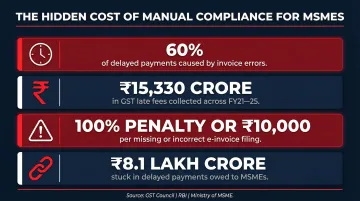
Faster, accurate invoicing accelerates payment collection. It also cuts the administrative burden of corrections and re-submissions—two direct levers on both cost and cash flow.
KPIs impacted:
- Days sales outstanding (DSO)
- Invoice error rate
- Billing cycle time
- Compliance penalty incidents
- Accounts receivable collection efficiency
Where the impact is greatest:
Automation delivers the highest return for businesses with high transaction volumes, multi-GST entity structures, or teams where billing and compliance are still handled manually. That describes most growing MSMEs.
Real-Time Reporting and Analytics
Real-time reporting means business leaders can access current performance data—revenue, expenses, outstanding invoices, inventory levels, cash flow—at any moment. No month-end wait. No manual consolidation across sources.
How ERP delivers this:
Data from operations, finance, and sales flows into the reporting layer continuously through connected dashboards and configurable reports. A manager can see today's position on any key metric without IT involvement or spreadsheet assembly. Platforms like Bizionix provide live dashboards with instant reporting that eliminates the traditional month-end waiting period.
Why this matters:
Decisions made on delayed or incomplete data carry real risk. Overstocking, underpricing, late collection follow-ups, and missed cost-saving opportunities all trace back to visibility gaps. Real-time reporting closes the distance between what is happening and what management knows.
The business impact is measurable:
- Cloud ERP implementation reduces decision-making cycle time by 30%
- AI integration within ERP platforms delivers a 35% improvement in decision-making speed
- Indian enterprises replacing legacy systems achieved up to a 35% reduction in financial closing cycles
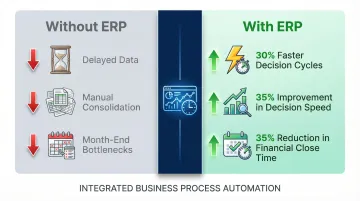
When every department's performance is visible in a shared system, it becomes easier to identify underperforming areas, recognize patterns early, and hold teams to measurable outcomes.
KPIs impacted:
- Financial close cycle time
- Cash flow forecast accuracy
- Report generation time
- Operational expense variance
- Management response time to anomalies
Where the impact is greatest:
Real-time reporting is especially critical for businesses with multiple cost centers, seasonal demand fluctuations, or leadership teams that currently rely on end-of-period data to assess business health.
What Happens When These ERP Features Are Missing or Underused
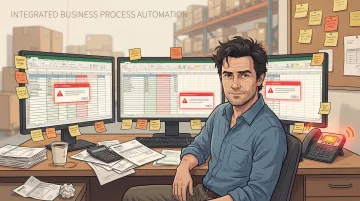
For Indian MSMEs, running without integrated ERP isn't just inefficient — it compounds into measurable losses. Here's what that looks like in practice:
Data fragmentation means finance and operations are rarely working from the same numbers. Reconciliation becomes a weekly ritual — and a costly one. Indian SMBs lose an average of ₹12,000 per month to duplicate invoice payments alone, driven by a 1.29% duplication rate in manual systems.
Manual invoicing, compliance filings, and inventory updates each carry a hidden tax: rework. Employees waste approximately 10 hours per month — 120 hours annually — on manual expense reporting alone, and errors in GST filings can escalate into penalty exposure.
No real-time reporting means management is always catching up. By the time a cash flow gap or overdue receivable surfaces, the damage is already done. The median debtor days for micro-enterprises was 195 days beyond the legally mandated 45-day payment period — a direct consequence of poor visibility into outstanding collections.
System gaps push businesses to hire more people just to keep up — not to grow, but to compensate. Inventory carrying costs reach 18% to 30% of annual stock value in spreadsheet-managed operations, a cost that compounds silently quarter after quarter.
Growth amplifies every gap. Adding a new branch, entity, or product line doesn't reset these problems — it multiplies them. Businesses that delay ERP adoption often find that what was a manageable inefficiency at ₹5 crore turnover becomes a structural bottleneck at ₹20 crore.
How to Get the Most Value from Your ERP System
ERP works best when it is not treated as a one-time implementation but as an ongoing operational practice. That means consistent team training, disciplined data entry, and reporting insights that are reviewed and acted on — not filed away.
Compounding value builds the longer the system captures accurate, consistent data — analytics become more reliable, and management decisions become more confident. For Indian MSMEs, this makes platform choice critical: look for built-in GST compliance, multi-entity support, and scalability rather than a generic system that requires heavy customisation.
To get there, focus on these operational disciplines:
- Train teams to use the system consistently, not just during go-live
- Maintain clean data entry standards across all departments
- Review reporting insights regularly and assign owners to act on them
- Set quarterly targets tied to specific outcomes (reduced DSO, faster closes, fewer reconciliation errors)
The Indian government actively supports this transition. The MSME Competitive (Lean) Scheme provides financial assistance for implementing ERP suites, covering 90% of the implementation cost, up to ₹2,40,000 for advanced levels.
The urgency to act is real. The India ERP market was valued at $1.78 billion in 2025 and is expected to reach $2.73 billion by 2031, growing at a CAGR of 7.39%, with over 40% of new implementations being cloud-based or SaaS-driven. MSMEs that build strong ERP habits now will be far better positioned as competition for that growth intensifies.
Conclusion
ERP features—integration, automation, and real-time reporting—deliver real value only when applied consistently. That consistent use is what builds operational control, financial clarity, and the decision confidence that compounds over time.
Businesses that embed ERP into their daily workflows progressively reduce waste, improve cash flow, and build the organizational visibility needed to scale without losing operational control.
The stakes are significant: with 75 million registered MSMEs in India employing 28.13 crore people and contributing 30% to GDP, the efficiency gains from ERP adoption ripple well beyond individual businesses.
Treat ERP adoption as an ongoing management discipline—a platform to engage actively as business complexity grows, not a system to configure once and leave running in the background.
Frequently Asked Questions
What are the key features of enterprise resource planning?
The core features include integrated data management across departments, financial and accounting automation, real-time reporting and analytics, compliance management (especially GST for Indian businesses), and process controls. These features work together rather than independently to create a unified business management system.
What are the 5 components of ERP?
The five widely recognized components are:
- Financial management — accounting, billing, and compliance
- Human resource management — payroll, attendance, and leave
- Supply chain and inventory — procurement and stock tracking
- Customer relationship management — sales, leads, and follow-ups
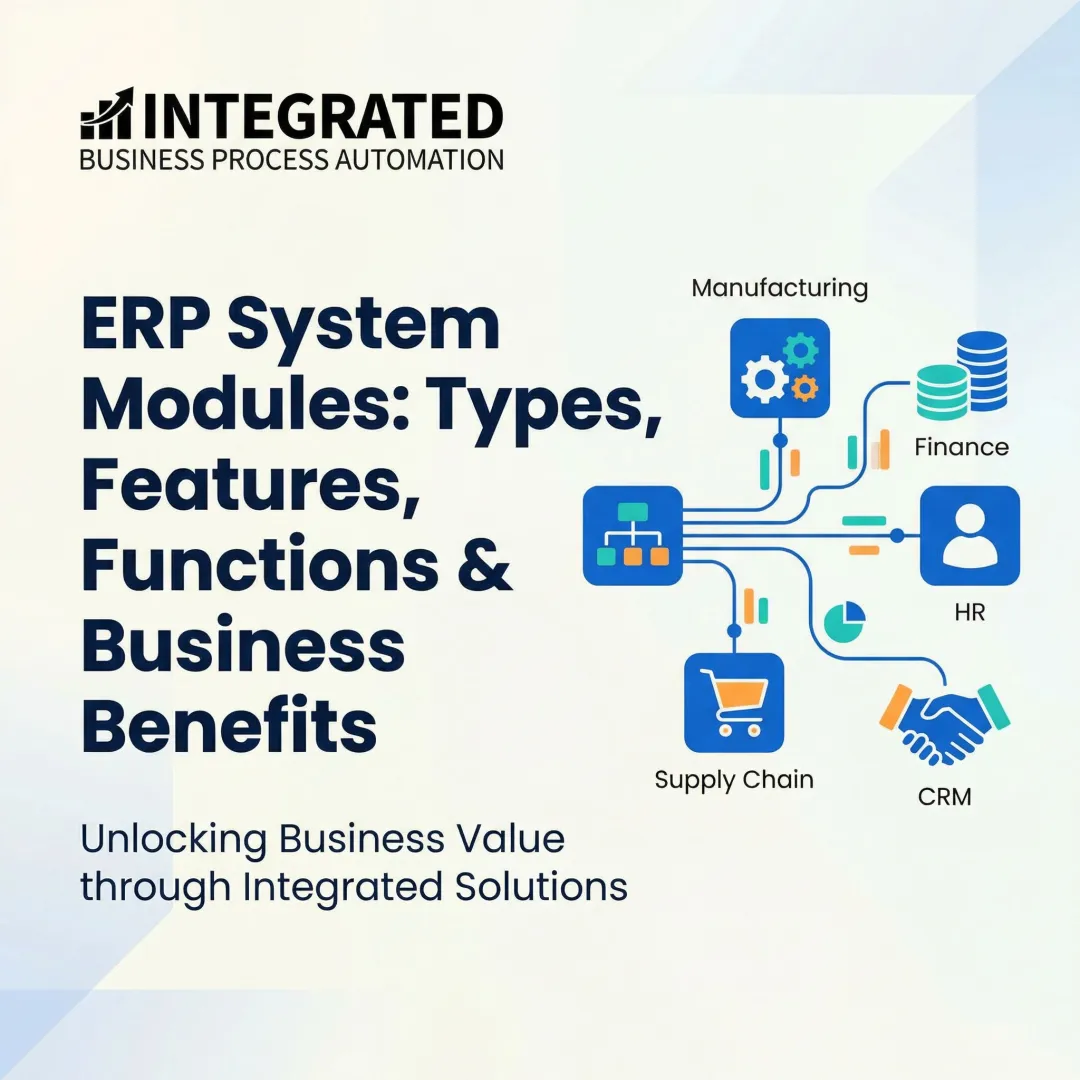
- Reporting and analytics — dashboards, MIS reports, and business intelligence
What are the 7 stages of implementation of ERP?
The seven typical stages are:
- Planning and needs assessment
- System selection based on business requirements
- Project team setup with defined roles
- Configuration and customization to match workflows
- Data migration from existing systems
- Testing and user training
- Go-live with ongoing support and optimization
What is the main benefit of ERP for small and mid-sized businesses?
The most immediate benefit for MSMEs is replacing fragmented manual processes with a single system. This improves accuracy, cuts administrative overhead, and gives management real-time visibility into operations — without requiring enterprise-scale resources or deep IT expertise.
How does ERP improve decision-making in a growing business?
A unified data model and real-time dashboards give leaders accurate, current information across finance, sales, inventory, and operations. This enables faster, more confident decisions on pricing, inventory, cash flow, and resource allocation instead of waiting on delayed or manually assembled reports.