Introduction
Since GST rollout in 2017, Indian businesses managing billing and accounting manually—or with disconnected tools—face continuous compliance risks:
- Calculation errors that trigger penalty notices
- Blocked Input Tax Credit (ITC) from mismatched filings
- Dispatch halts due to invalid e-invoices
- Reconciliation gaps that invite automated scrutiny
For MSMEs issuing B2B invoices, multi-location enterprises, franchise networks, and businesses approaching the ₹5 crore e-invoicing threshold, GST-ready ERP software has moved from a convenience to an operational necessity.
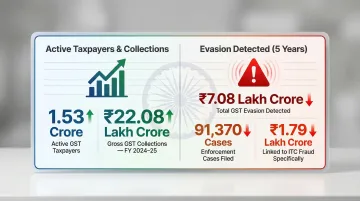
As of June 2025, India's GST network supports 1.53 crore active taxpayers, with FY 2024–25 recording gross collections of ₹22.08 lakh crore. Enforcement has scaled alongside: over the last five financial years, authorities detected ₹7.08 lakh crore in GST evasion across 91,370 cases, with ₹1.79 lakh crore directly linked to ITC fraud.
Fragmented tools—standalone billing software, separate GST portal logins, and spreadsheets—are a primary source of these gaps. They create reconciliation mismatches that trigger automated notices and leave businesses exposed during audits.
This guide covers the best GST-ready ERP software for billing and accounting in India, the features that matter most, and how to match a solution to your business size and compliance requirements.
TL;DR
- GST-ready ERP automates tax calculations, e-invoicing (IRN/QR generation), e-way bills, and GSTR preparation—eliminating manual compliance risk
- Top solutions unify billing, inventory, accounting, and multi-branch operations in one platform—not siloed tax tools
- Evaluate platforms on GST API integration, e-invoicing support, multi-GSTIN handling, ITC reconciliation, and growth scalability
- Leading GST-ready ERPs for Indian MSMEs: Bizionix, Zoho Books, TallyPrime, Marg ERP, and Busy Accounting Software
- Bizionix offers direct IRP API integration, multi-company management under a single login, and purpose-built design for Indian MSMEs
What Is GST-Ready ERP Software and Why Does It Matter for Indian Businesses?
GST-ready ERP software is an integrated business management platform that natively embeds GST compliance into every transaction — not as an add-on, but as the system's core design. A purpose-built platform handles all of the following natively:
- Auto-applies CGST/SGST/IGST based on place of supply
- Generates e-invoices with IRN and QR codes via direct IRP connection
- Creates e-way bills with pin-to-pin distance calculation
- Prepares GSTR-1 and GSTR-3B data automatically from billing records
The business risk of operating without one is severe. Since January 2022, ITC claims are strictly limited to invoices appearing in GSTR-2B — the 5% provisional buffer is gone. Fragmented tools create data mismatches between purchase registers and supplier filings, triggering automated notices and cash flow blockages.
Over five years, authorities detected ₹1.79 lakh crore in ITC fraud-related evasion and continue to bust syndicates passing inadmissible credits.
For businesses crossing the ₹5 crore turnover threshold, e-invoicing is mandatory. As of April 2025, companies with ₹10 crore+ AATO must report invoices to the IRP within 30 days — late reporting blocks IRN generation entirely, rendering invoices legally invalid. Manual JSON uploads and portal juggling no longer scale at this level.
Choosing the right platform means looking beyond basic return filing. The solutions evaluated below were assessed on compliance depth (direct API integration), ITC reconciliation capability, multi-GSTIN support, deployment model, and fit for Indian MSME operations.
Best GST-Ready ERP Software for Billing & Accounting in India
These platforms were shortlisted based on six criteria:
- GST compliance completeness and e-invoicing integration
- E-way bill automation and ITC reconciliation capability
- Multi-GSTIN support and deployment flexibility
- Proven track record serving Indian MSMEs
Bizionix
Bizionix is a cloud-based ERP platform developed by IIS-LLP, a subsidiary of Protocol India Private Limited, backed by over two decades of industry experience. Built specifically for Indian MSMEs, it covers billing, accounting, inventory, procurement, HRMS, and GST compliance in a single unified system—eliminating the fragmentation of managing 5-6 separate tools.
What sets Bizionix apart: direct API integration with the GST e-Invoice system for instant IRN generation (no manual JSON uploads), multi-company management under a single secure login (ideal for business groups, franchises, and CA firms managing client portfolios), 100% cloud-based real-time visibility, and enterprise-grade compliance without SAP-level complexity or cost.
| Feature | Details |
|---|---|
| Key GST Features | Automated e-invoicing with direct IRN and QR code generation via GST API, e-way bill integration, GSTR-ready reports, ITC tracking, multi-GSTIN support under single login |
| Deployment & Scalability | 100% cloud-based SaaS; scales across multiple companies, branches, and locations without additional infrastructure |
| Best Suited For | Indian MSMEs, multi-entity business groups, franchise networks, manufacturing, distribution, hotels, and CA firms managing client portfolios |
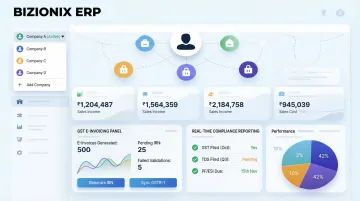
Bizionix offers a 14-day free trial on the NEO plan (₹999/year) and custom Enterprise pricing for advanced multi-company needs. Setup takes minutes—connect your GSTIN and API credentials, and start generating compliant invoices immediately. The platform replaces manual processes with defined workflows, real-time dashboards, and audit-ready records—a practical upgrade path for businesses moving away from Tally or spreadsheets.
Zoho Books
Zoho Books is a cloud-based accounting and finance platform from Zoho Corporation, widely adopted by Indian SMEs for its GST compliance features, integration with the broader Zoho ecosystem (CRM, Inventory, Projects), and competitive pricing tiers starting with a free plan for businesses under ₹25 lakh revenue.
Automated GSTR filing preparation, e-invoicing with IRN support via GSP integration, bank reconciliation, and seamless data flow across Zoho apps make it a strong choice for service businesses and startups already using Zoho tools.
| Feature | Details |
|---|---|
| Key GST Features | E-invoicing with IRN, GSTR-1/3B preparation, TDS/TCS tracking, HSN/SAC code support, automated tax calculations, GSTR-2B reconciliation via IMS |
| Deployment & Scalability | Cloud-based SaaS; tiered plans from Free to Ultimate (₹9,599/month billed annually); scales from freelancers to growing businesses |
| Best Suited For | Service businesses, startups, and SMEs already using Zoho CRM or other Zoho apps |
Zoho Books' clean UI and workflow automation make it accessible for non-accountants, though businesses with complex manufacturing or multi-location inventory may find TallyPrime or Marg more suited to their needs.
TallyPrime
TallyPrime by Tally Solutions is India's most widely used accounting and business management software, with decades of presence across millions of businesses in retail, manufacturing, distribution, and services. Its deep GST return filing capabilities, offline-first architecture with optional cloud access (via TallyPrime Server and Connected Services), and vast network of certified partners make it the most auditor-accepted option in the market.
Strengths include GSTR-1/2A/3B reconciliation, ITC mismatch reports, multi-GSTIN ledger management, and robust audit trail features. Its interface and module structure differ from modern cloud-native ERPs, and multi-user access requires on-premise installation with server setup.
| Feature | Details |
|---|---|
| Key GST Features | GST invoicing, e-invoicing with IRN, e-way bill generation, GSTR-1/2A/3B reconciliation, ITC mismatch reports, multi-GSTIN ledger management |
| Deployment & Scalability | On-premise with TallyPrime Server for multi-user; TallyPrime 4.0+ includes Connected Services for cloud access; Silver ₹22,500, Gold ₹67,500 (perpetual) + TSS renewals |
| Best Suited For | Established Indian businesses across all sizes that prefer familiar desktop accounting with GST compliance depth |
TallyPrime remains the preferred choice for businesses with dedicated accounting staff and established workflows, though cloud-first startups may find Zoho Books or Bizionix more intuitive.
Marg ERP
Marg ERP is an India-specific ERP solution with strong penetration in pharmaceutical distribution, FMCG, retail, and manufacturing sectors—known for GST-ready billing, barcode support, and industry-specific modules like batch tracking, expiry management, and medicine substitute search.
Its vertical-specific compliance features, GST billing with HSN/SAC codes, and e-way bill automation are backed by an extensive offline-capable installation base with a wide dealer network across Tier 2 and Tier 3 cities.
| Feature | Details |
|---|---|
| Key GST Features | GST billing with HSN/SAC codes, e-way bill generation, GSTR filing support (1, 2, 3B, 9), ITC reconciliation, industry-specific tax handling (pharma, FMCG) |
| Deployment & Scalability | On-premise and cloud hybrid (Marg Cloud); suitable for single-location to multi-branch operations; Nano ₹5,550, Basic ₹10,300, Gold ₹26,000 + ARC |
| Best Suited For | Pharmaceutical distributors, FMCG wholesalers, retailers, and manufacturers in Tier 2/3 markets |
Marg's pharma-specific features (batch/expiry tracking, POS, substitute search) make it indispensable for medicine distribution, though its UI is less modern than cloud-native alternatives.
Busy Accounting Software
Busy Accounting Software is a GST-ready business accounting solution popular among Indian SMEs for its affordability, comprehensive accounting features, and strong GST compliance toolkit across trading, manufacturing, and service businesses.
Key capabilities include multi-location inventory management, GST return preparation with direct portal integration, e-invoicing with IRN and QR code generation (via NIC-IRP digital signing), e-way bill generation, and a simplified interface suited to small business owners without dedicated accounting staff.
| Feature | Details |
|---|---|
| Key GST Features | GST invoicing, e-invoicing with IRN and QR code, e-way bill, GSTR-1/3B/2A/2B reconciliation, HSN/SAC validation, interest and late fee calculation |
| Deployment & Scalability | Desktop, Busy Online (cloud), and mobile; Basic ₹9,999/year, Enterprise ₹19,999/year, Cloud from ₹10,800/year |
| Best Suited For | Small trading businesses, retailers, and service providers requiring affordable GST compliance with inventory management |
Busy's multi-branch management and voucher approval workflows make it suitable for wholesalers and distributors, though businesses needing advanced manufacturing or hotel-specific modules may prefer Bizionix or Marg.
Key Features Every GST-Ready ERP Must Have
E-invoicing with direct IRN generation
For businesses above the ₹5 crore AATO threshold—expected to extend to ₹3 crore in upcoming revisions—e-invoicing is legally mandatory. The ERP must connect directly to the Invoice Registration Portal (IRP) via API—not through manual JSON uploads—to generate IRN and QR codes in real time. As of April 2025, businesses with ₹10 crore+ AATO must report invoices within 30 days of invoice date; late reporting blocks IRN generation, rendering invoices invalid.
The GST network processes approximately 11 million IRNs daily, with 2 billion generated in FY 2025–26. Your ERP must have built-in, direct API connectivity to authorized IRPs with multi-IRP failover to prevent dispatch holds during server downtimes. Supported portals include:
- NIC (National Informatics Centre)
- Cygnet
- Clear
ITC reconciliation and GSTR matching
Input Tax Credit mismatches between purchase invoices and GSTR-2B data are the most common cause of GST notices. Since January 2022, ITC claims are strictly limited to invoices in GSTR-2B—no provisional buffer.
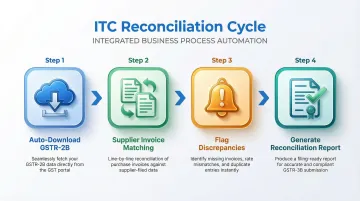
A capable ERP must handle the full reconciliation cycle before you file GSTR-3B:
- Auto-downloads GSTR-2B from the GST portal
- Matches supplier invoices against GSTR-2B line by line
- Flags discrepancies — missing invoices, rate mismatches, duplicate claims
- Generates reconciliation reports ready for review
Rule 86B adds another layer: businesses with monthly taxable supply exceeding ₹50 lakh cannot use ITC to discharge more than 99% of output tax — at least 1% must be paid in cash. Your ERP should calculate this threshold automatically.
Multi-GSTIN and multi-branch support
For businesses with operations across states or multiple entities, the ERP must manage distinct GSTINs, generate state-wise returns, and consolidate reporting under a single interface. Single-company billing tools are insufficient—you need entity-level data isolation with group-level dashboards, seamless switching between entities without logout, and independent GSTR filing per GSTIN.
Automated e-way bill generation
E-way bills are mandatory for goods movement above ₹50,000 consignment value (inter-state and intra-state). Validity periods depend on cargo type:
- Regular cargo: 1 day per 200 km
- Over-dimensional cargo (ODC): 1 day per 20 km
The system recorded 46.37 crore inter-state and 84.09 crore intra-state e-way bills in the period ending February 2025.
Your ERP should auto-populate vehicle details, consignee/consignor data, and pin-to-pin distance from transaction records, reducing logistics delays and manual errors. Recent validations prevent e-way bill generation for documents older than 180 days.
How We Chose the Best GST-Ready ERP Solutions
These solutions were assessed on five dimensions: depth of GST API integration (direct IRN generation vs. manual upload), ITC reconciliation accuracy (auto-matching GSTR-2B vs. manual spreadsheets), multi-GSTIN management capability, total cost of ownership relative to features offered, and scalability for MSME growth stages.
Common buyer mistakes:
- Choosing GST software that handles only return filing but lacks integrated billing, inventory, or accounting—resulting in continued data fragmentation
- Selecting enterprise platforms (like SAP Business One at ₹1.5–2.5 lakh per user) with excessive complexity and cost requiring dedicated IT teams
- Opting for generic international accounting platforms (QuickBooks, Xero) that lack deep HSN/SAC validation, place-of-supply logic, and GSTR format compliance
Why built-for-India matters:
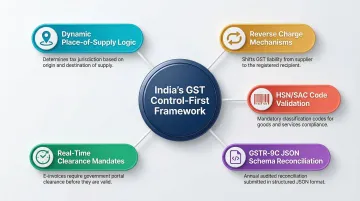
India's GST framework operates on a "control-first" regulatory philosophy: the system validates data via IRP before a transaction legally occurs, contrasting with the global "trust but verify" model. Generic international tools struggle with India-specific requirements, including:
- Dynamic place-of-supply logic
- Reverse charge mechanisms
- HSN/SAC code validation
- JSON schemas for GSTR-9C reconciliations
- Real-time clearance mandates
India-built platforms like TallyPrime, Zoho Books, and Bizionix build these in by default and update automatically with regulatory changes, so compliance is maintained without manual workarounds.
Conclusion
In India's GST-governed environment, compliance failures carry direct financial consequences: penalties, ITC reversals, blocked dispatch, and audit triggers. Over five years, authorities detected ₹7.08 lakh crore in evasion, with ₹1.79 lakh crore linked to ITC fraud. The right ERP eliminates these risks while improving billing cycle speed, cash flow visibility, and operational efficiency.
Evaluate beyond feature lists. The right choice comes down to four factors:
- Regulatory track record — how quickly the vendor updates for CBIC/GSTN changes
- Integration depth — direct API connection to GSTN vs. manual upload workarounds
- Scalability — support for multi-entity or multi-location growth without added complexity
- Total cost of ownership — licensing, implementation, and ongoing support combined
Bizionix is built for Indian MSMEs that need direct IRN generation, multi-company management, and cloud-based real-time visibility without enterprise-level complexity or cost. Explore Bizionix or request a demo to see how it fits your billing and accounting needs. A 14-day free trial and quick setup mean you can move from manual processes to automated compliance without a lengthy transition.
Frequently Asked Questions
What is GST-ready ERP software?
GST-ready ERP is an integrated business management platform that natively handles GST calculations, e-invoicing, e-way bills, ITC reconciliation, and GSTR return preparation across all transactions. Unlike standalone GST filing tools, it covers the full transaction lifecycle, not just return submission.
Is e-invoicing mandatory for all businesses in India?
E-invoicing is mandatory for businesses with annual aggregate turnover (AATO) above ₹5 crore. The threshold has been progressively lowered from ₹500 crore in 2020, and as of April 2025, businesses with ₹10 crore+ AATO must report invoices to the IRP within 30 days of the invoice date.
What is the difference between GST billing software and GST ERP software?
GST billing software handles invoicing and tax calculations only, while GST ERP software integrates billing with accounting, inventory, procurement, multi-branch management, and compliance reporting. This makes ERP the more complete solution for growing businesses with complex operations.
Can a GST ERP handle multiple GSTINs under one account?
Yes, modern GST ERP platforms support multiple GSTINs under a single login, allowing businesses with multi-state operations or multiple entities to manage distinct registrations, file returns separately, and view consolidated financial reports through entity-level dashboards.
How does ITC reconciliation work in a GST ERP system?
The ERP auto-downloads GSTR-2B data from the GSTN portal and matches it against purchase invoices recorded in the system. It then flags mismatches—missing invoices, rate differences, or duplicate claims—and generates reconciliation reports so your finance team can claim accurate Input Tax Credit before filing GSTR-3B.
What should an MSME look for when choosing GST-ready ERP software?
Key factors to evaluate:
- Direct API integration for e-invoicing, not just JSON upload
- Automated ITC reconciliation with GSTR-2B
- Multi-GSTIN support for multi-state or multi-entity operations
- Cloud deployment for real-time access
- Scalability as your business grows
- Vendor history of timely GST regulatory updates