Introduction
A distributor in Pune builds a website to attract clients, then realizes she can't track inventory or generate GST invoices from it. A manufacturer in Hyderabad buys an ERP, then wonders why it can't publish product pages. Both made the same mistake: picking the wrong tool for the job. The confusion between a CMS (Content Management System) and an ERP (Enterprise Resource Planning) system is understandable — but buying the wrong one wastes both money and time.
For Indian MSMEs, this decision carries real financial weight. Buying one when you need the other means spending on software that doesn't solve your actual bottleneck. According to industry data, 94% of Indian MSMEs have internet access, yet only 12% have adopted ERP software and just 19% maintain a functional website — suggesting most businesses are underserved by both categories.
This article provides clear definitions, a structured comparison, integration scenarios, and a practical decision guide to help you choose the right tool for your business stage.
TL;DR
- CMS handles your digital front-end: website content, product pages, and blogs
- ERP runs your operational back-end: inventory, finance, procurement, and compliance
- Marketing teams use CMS; operations and finance teams use ERP
- E-commerce businesses benefit most from integrating both for real-time inventory sync
- Indian MSMEs typically need ERP first — GST compliance and operational control take priority
- The two systems don't compete; choose based on where your business pain is right now
CMS vs ERP: At a Glance
| Feature | CMS | ERP |
|---|---|---|
| Primary Purpose | Manage digital content and customer-facing web presence | Manage internal operations and business resources |
| Primary Users | Marketing teams, content creators, e-commerce managers | Finance teams, operations managers, procurement heads, business owners |
| Data Type | Unstructured content (text, images, videos, web pages) | Structured transactional data (invoices, purchase orders, stock levels, payroll) |
| Core Features | Content authoring, SEO tools, website templates, e-commerce functionality | Financial accounting, inventory management, procurement, HR, GST compliance reporting |
| Business Impact | Drives customer acquisition and digital presence | Reduces operational errors, improves compliance, provides real-time visibility |
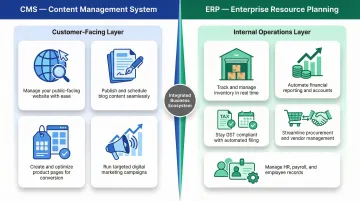
CMS operates at the customer-facing layer: what visitors see and interact with on your website. ERP handles the internal operational layer — the processes that keep the business running behind the scenes.
Both systems can be cloud-based, both automate repetitive tasks, and both centralize data. That overlap is what creates confusion. The key distinction is which domain each system controls: one manages your digital presence, the other manages your business operations.
What is a CMS?
A Content Management System (CMS) is software that enables businesses to create, manage, and publish digital content—websites, blog posts, product listings, landing pages—without requiring coding knowledge. Popular examples include WordPress (which holds roughly 59.9% of the global CMS market) and Shopify (7.2% market share).
Key Features:
- Content authoring and scheduling with visual editors
- SEO optimization tools for search visibility
- Website design via customizable templates
- E-commerce functionality for online stores
- Third-party integrations (analytics, payment gateways, social media)
Use Cases of a CMS
CMS platforms are most valuable when digital presence drives business outcomes:
- Content publishers — media companies, blogs, and agencies use CMS to schedule posts, manage content libraries, and optimize for search
- E-commerce businesses — manage product catalogs, process orders, and update storefronts without developer involvement
- Lead-generation businesses — consultants, agencies, and service firms attract and convert visitors through CMS-managed websites
CMS handles the customer-facing layer: attracting visitors, presenting offerings, and supporting digital marketing. It has no role in procurement, inventory, payroll, or financial compliance — which is where ERP takes over.
What is an ERP?
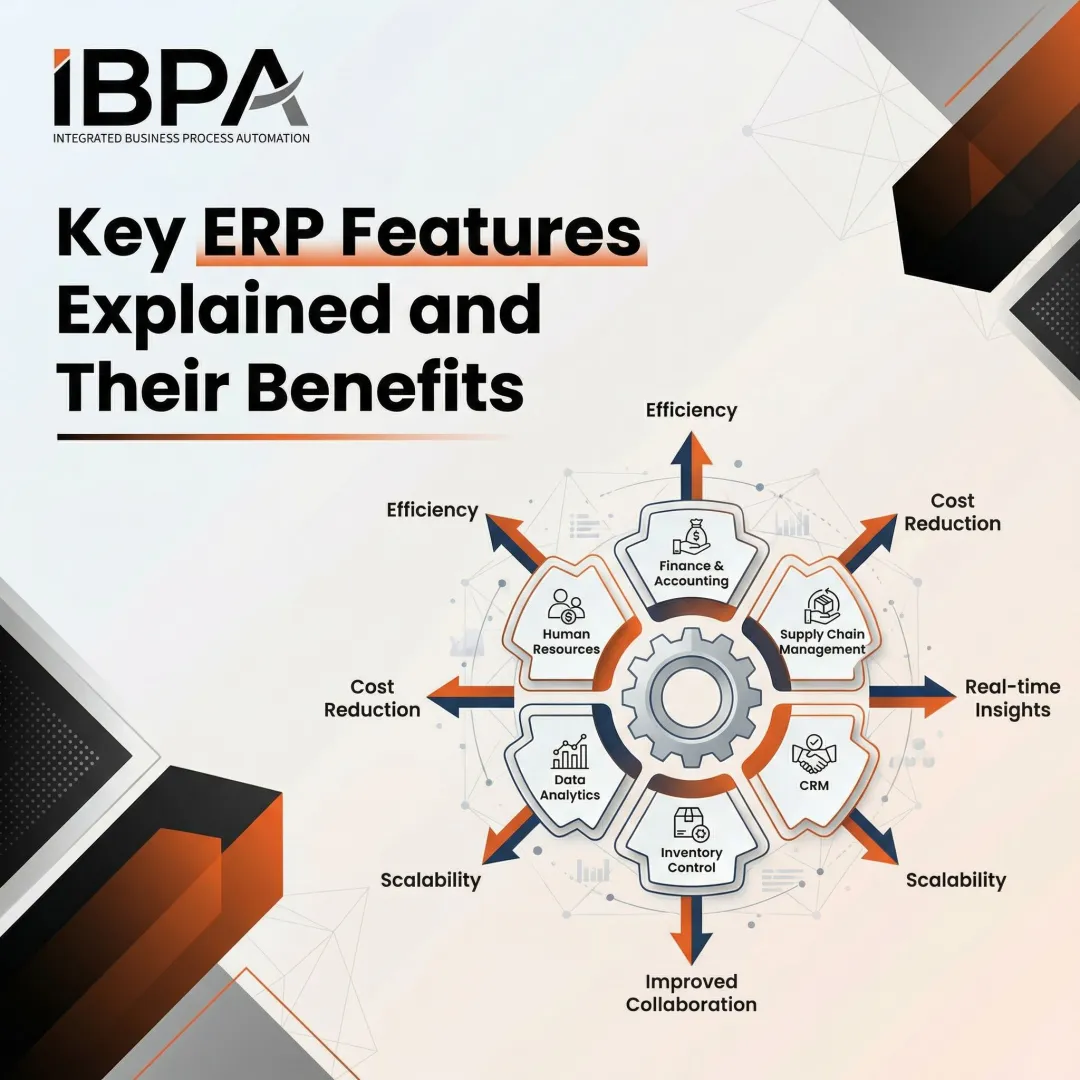
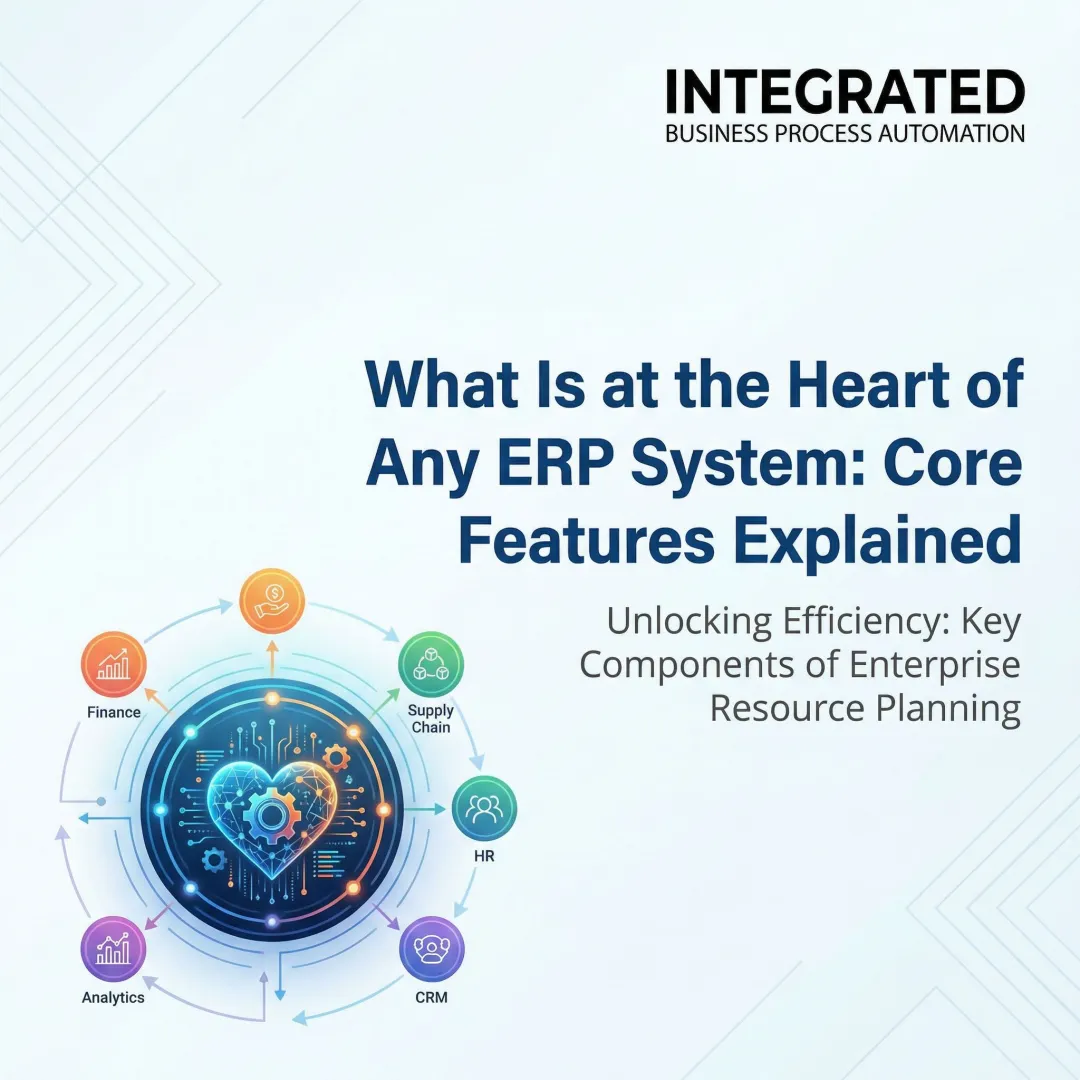
Enterprise Resource Planning (ERP) is a unified software platform that manages core business operations through a single system and a single source of data. It connects finance and accounting, inventory, procurement, sales order management, human resources, and compliance — eliminating the silos that come with running separate tools.
Why ERP Matters for Growing Businesses:
As companies scale, managing operations through spreadsheets, standalone tools, or manual processes creates data silos, errors, and operational blind spots. Research shows that 94% of business spreadsheets contain errors, making them unreliable for critical decisions. ERP eliminates this fragmentation.
Key ERP Modules:
- Financial Management: Accounts, GST, invoicing, TDS, bank reconciliation
- Inventory & Warehouse: Multi-location stock tracking, consumption analytics
- Purchase & Sales: Order processing, vendor management, automated workflows
- HR & Payroll: Attendance, leave, salary processing, statutory compliance
- Reporting & Analytics: Real-time dashboards, P&L, balance sheet, MIS reports
Business Impact:
ERP adoption delivers reduced manual errors, real-time visibility across departments, faster billing cycles, and stronger compliance posture. For Indian MSMEs managing GST filings and e-invoicing mandates, these benefits directly impact profitability.
India's e-invoicing mandate now applies to businesses with annual turnover of just ₹5 crore. Effective April 2025, businesses over ₹10 crore must report invoices within 30 days or face IRN generation restrictions.
Use Cases of ERP
ERP addresses distinct operational challenges across business types:
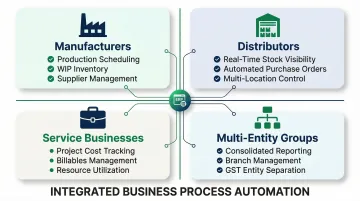
- Manufacturers — Track work-in-progress inventory, schedule production workflows, and manage supplier relationships across procurement cycles
- Distributors — Maintain real-time stock visibility across locations, automate purchase orders, and control warehouse operations from one platform
- Service Businesses — Monitor project costs, billables, and resource utilization with integrated time tracking and financial management
- Multi-Entity Groups — Consolidate reporting across subsidiaries, branches, or GST entities while maintaining entity-level independence
MSME-Specific Value:
An ERP built for Indian businesses — like Bizionix — offers GST-ready accounting, automated e-invoicing with direct IRN generation, and multi-company management, all without SAP-level complexity or cost. For MSMEs that have outgrown spreadsheets and disconnected tools, this means one login, one dashboard, and one system covering every function that drives the business.
CMS vs ERP: Key Differences That Actually Matter
CMS and ERP solve fundamentally different problems — one shapes how customers experience your business, the other controls how your business actually runs. Here's how they differ across the dimensions that matter most:
| Dimension | CMS | ERP |
|---|---|---|
| Core Focus | Customer experience and digital presence | Internal operations and resource management |
| Primary Users | Marketing teams, content creators, e-commerce managers | Finance teams, operations managers, procurement heads |
| Data Type | Unstructured content — text, images, videos, web pages | Structured transactional data — invoices, purchase orders, stock levels, payroll |
| Integration Direction | Outward: social media, SEO tools, payment gateways, analytics | Inward: accounting software, CRM, GST portals, logistics, HR platforms |
| Compliance Scope | Web standards — accessibility, privacy policies, SEO best practices | Financial and regulatory — tax laws, GST filings, audit trails, statutory reporting |
The compliance gap is where this distinction becomes most consequential for Indian MSMEs. An invoice issued without an IRN by a mandated taxpayer is legally invalid under Rule 48(4) of the CGST Rules. ERP systems handle this automatically; CMS platforms have no mechanism to do so.
When Does CMS and ERP Integration Make Sense?
Core Use Case:
E-commerce businesses that have both a customer-facing storefront (managed in CMS) and back-end inventory and order fulfillment (managed in ERP) benefit from integration. Without it, product availability, pricing, and order status must be updated manually across both systems—leading to errors and delays.
Key Benefits When Done Right:
- Real-time synchronization of inventory and product data between storefront and ERP
- Automated order processing that triggers fulfillment workflows
- Accurate customer-facing information (stock availability, delivery timelines) without manual intervention
Primary Challenges:
Integration requires significant planning and technical groundwork. Common obstacles include:
- Different platforms use incompatible data structures and API connection methods
- IT teams frequently spend a disproportionate share of their time building and maintaining custom integrations
- Project timelines slip when integration complexity is underestimated at the planning stage
- Most enterprise environments still run disconnected applications, meaning there's no ready-made bridge between systems
Practical Decision Criteria:
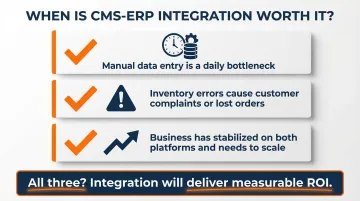
Integration is worth pursuing when:
- Manual data entry between systems is a daily bottleneck
- Inventory errors on the website cause customer complaints or lost orders
- The business has stabilized on both platforms and needs to scale efficiently
If your business is still early-stage or primarily operations-focused, the smarter move is to get your ERP foundation right first. A well-configured ERP handles the operational core — once that's stable, integrating a CMS becomes far more straightforward.
Which Tool Does Your Business Actually Need?
Start by identifying your primary pain point. If your biggest challenge is operational—untracked inventory, manual invoicing, compliance errors, fragmented reporting—the answer is ERP. If the challenge is digital visibility—no website, poor content management, weak e-commerce presence—the answer is CMS.
Most MSMEs have both challenges, but one is more urgent.
Choose CMS if:
- Your revenue depends on online content, digital marketing, or e-commerce
- You lack a proper platform to manage your digital presence
- Customer acquisition is your primary bottleneck
Choose ERP if:
- Your teams are drowning in spreadsheets
- You're chasing unpaid invoices or managing stock manually
- You're struggling with GST compliance or facing e-invoicing mandates
- Your turnover exceeds ₹5 crore (triggering mandatory e-invoicing)
Choose Both (with Integration) when:
- You have a mature e-commerce operation
- Real-time data sync between storefront and operations creates measurable business value
- Manual order processing is causing shipping errors or overselling
For most growing Indian businesses, ERP adoption delivers faster and more measurable ROI because it addresses operational bottlenecks that directly affect profitability—cost leakage, billing delays, compliance risks, and cross-team coordination.
Independent research shows ERP payback periods average 16 months, with average returns exceeding 200%. Cloud ERP deployments deliver 4.01 times the ROI of on-premises systems.

For Indian MSMEs specifically, that ROI case is strengthened by compliance pressure. Bizionix covers finance, inventory, sales, and GST e-invoicing in a single platform—configured via API key, not a months-long implementation project.
Conclusion
CMS and ERP solve different problems at different layers of the business. CMS handles what customers see; ERP handles what keeps the business running. Choosing between them is really a question of where your biggest operational gap sits right now.
For most MSMEs, that gap tends to be internal — in compliance, cash flow visibility, inventory control, or payroll accuracy. A well-designed website won't fix those. ERP will.
Ask three questions before deciding:
- Where is the business losing the most time or money today?
- Is the gap customer-facing (content, experience) or operations-facing (process, data, compliance)?
- Can the current setup scale, or will it break as transaction volumes grow?
For growing Indian MSMEs navigating GST compliance, multi-location inventory, and tighter margins, starting with ERP typically delivers faster, more measurable returns. Platforms like Bizionix are built specifically for this — consolidating operations into a single system without the cost or complexity of enterprise-grade software.
Frequently Asked Questions
What does CMS ERP integration mean?
A CMS ERP system refers to the integration of a Content Management System and an ERP platform, allowing businesses to manage both customer-facing digital content and back-end operations—such as inventory and order data—within a connected framework.
What is the difference between CMS and ERP?
CMS manages front-end digital content (websites, product pages, blogs) while ERP manages back-end operations (finance, inventory, procurement, compliance). They serve different user bases and manage entirely different types of business information.
Can a CMS replace an ERP?
No. A CMS lacks the modules needed to manage financial transactions, inventory, procurement, or GST compliance. They are fundamentally different software categories built for different business functions.
Do small businesses need both a CMS and an ERP?
Most MSMEs don't need both immediately. Businesses with operational complexity—inventory, GST filing, payroll—typically benefit from ERP first. Those built primarily around web traffic or e-commerce may need a CMS earlier.
Which should I implement first — CMS or ERP?
For most MSMEs, ERP comes first. It resolves the operational inefficiencies—manual processes, compliance errors, financial leakage—that directly hurt profitability. Digital presence becomes the priority only once core operations are stable.
Does an ERP have a built-in CMS?
Some ERP platforms include basic web content or e-commerce modules, but these typically lack the advanced SEO tools, design flexibility, and marketing features of a dedicated CMS. For businesses that need both, integrating a dedicated CMS with their ERP is usually the more effective path.